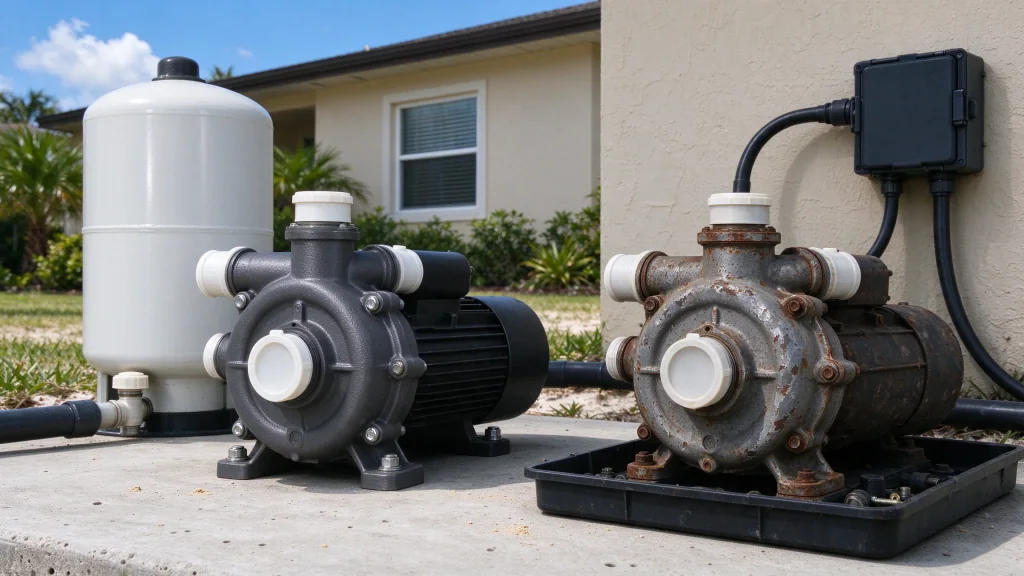
Make the decision about the failed component
A pump system contains several parts that can interrupt the same water supply. A pressure switch may stop calling for a healthy motor to run. A damaged tank can make that motor start repeatedly. A leak can prevent pressure from reaching the house. Before comparing repair and replacement, ask which finding establishes that the pump itself is defective. Our no-water diagnosis describes the first separation between supply, controls and pumping equipment.
Coastal Palm Bay Well Pump Repair organizes the work around that distinction. A useful recommendation names the fault, explains what testing supports it and identifies the parts that will remain. If the assessment only repeats the original symptom, there is still a missing step. Replacing equipment without understanding the failure can restore water briefly while leaving the cause of the breakdown untouched.
When a focused repair is a sensible purchase
An accessible control, a leaking connection or a defective pressure tank can justify its own repair without replacing the pump. The condition of the remaining equipment matters. A new control is a reasonable investment when the motor and hydraulic performance are acceptable and the control is the confirmed fault. It is less useful when another established defect will continue to interrupt delivery. See pressure-switch and control repair for the differences between control components.
Repairs should also address the reason a part failed where that reason can be established. For example, repeated motor starts may relate to lost usable tank storage. Replacing a damaged starting component without assessing the cycling behavior can leave the system under the same stress. A separate pressure tank replacement may be appropriate, but a tank should not be added automatically just because a pump estimate is being prepared.
What makes replacement the stronger option
Replacement becomes more persuasive when testing identifies a failed motor or damaged pumping assembly, performance is no longer adequate under the required conditions, or a suitable repair is impractical. The replacement still needs a selection reason. Horsepower is only one label. Water level, delivery pressure, flow requirement, pipe losses and the available electrical arrangement affect whether a proposed pump can do the job.
Access changes the comparison. A surface jet pump and a submersible unit require different work to reach. With a belowground pump, retrieval, cable and drop-pipe condition can materially affect the scope. That does not prove every pulled pump should be replaced. It means the comparison should include the cost and purpose of access, the condition found and what the proposed well pump replacement actually includes.
Read the scope beside the total
A pump-only replacement can retain a serviceable tank, controls, pipe and cable. A broader package may replace some of those items. Comparing their totals without the descriptions makes the difference look like a disagreement about the price of one pump. Ask for the equipment specification, retained components, additional-work assumptions and completion checks. Our cost guide explains why access and connected components change the expense.
A higher-capacity pump is not a substitute for investigating an inadequate source. If delivery fades during use and improves after a rest, the source response deserves attention alongside the equipment. The pump-versus-low-yield guide explains that branch of diagnosis. Likewise, a larger motor does not remove a downstream restriction or restore failed tank storage. A pressure-versus-flow comparison helps you ask what improvement is actually being proposed.
Keep access and the repair itself separate in the discussion. Retrieving a submersible pump may reveal a damaged drop pipe or cable that could not be judged from the surface. Ask which findings are already established, what remains conditional, and when the next decision will be made. That makes an inspection allowance understandable without treating every possible discovery as an approved replacement.