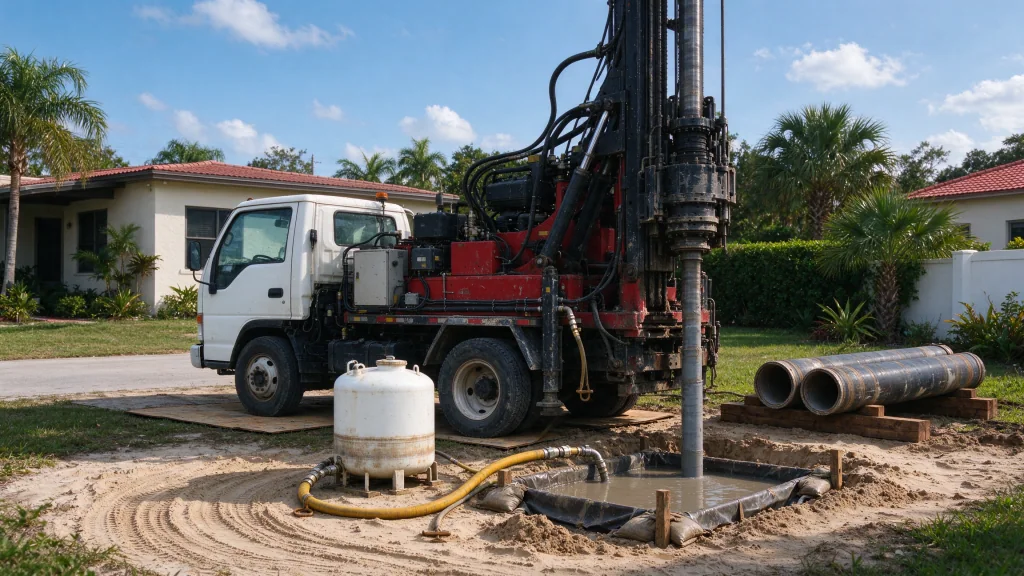
When a Palm Bay property needs a new well
Coastal Palm Bay Well Pump Repair offers water well drilling and complete new well installation for properties in Palm Bay and nearby south Brevard communities. The work covers the well itself and, when requested, the pump, pressure tank, controls and buried line that carry water into the building. Drilling and well construction are performed by a Florida-licensed water well contractor, as state law requires.
Owners usually arrive at this decision from one of a few directions. A new home on a rural lot without public water needs a drinking water source. An older well may have failed in a way that repair or well rehabilitation cannot reasonably correct, such as damaged casing or a source that no longer meets demand. Some properties want a dedicated irrigation supply so the lawn stops competing with the house. Others discover during a well system inspection that the existing well is unusable and needs replacing before a sale. Each starting point changes the design, so the first conversation is about what the water will be used for.
Who may construct a water well in Florida
Florida Statutes section 373.323 makes a water well contractor license issued by a water management district the only water well contractor license needed to construct, repair or abandon a well in the state. The Florida Department of Health in Brevard County tells anyone planning to install or abandon a well to contact a Florida licensed water well contractor. We arrange the project and the drilling is carried out under that license.
The statute also draws a line that matters for scope. Under section 373.303, installing pumps and pumping equipment is not "construction of water wells." Replacing a pump in a sound well is equipment work, covered on our submersible pump repair page. Drilling a bore, setting casing and sealing it is construction, with its own permit and inspection path. Our Florida well permit guide explains where that boundary sits.
How Brevard permitting depends on diameter and location
Who issues the permit depends on the well's diameter and the parcel. DOH-Brevard permits wells under 6 inches in diameter, except in delineated areas. The St. Johns River Water Management District permits wells 6 inches or larger and every well inside a delineated area. DOH-Brevard monitors potable wells around certain chemical-risk sources and there is a delineated area in the county, so parcel status is confirmed per address. Applications for both go through the District's ePermit system.
Wells are installed under Chapters 40C-3 and 62-532 of the Florida Administrative Code. A well permit does not relieve the owner of county, municipal, utility, drainage-easement or reclaimed-water requirements, so those are checked for the specific address rather than assumed. Where groundwater protection requires it, state law calls for permission before construction begins, which is why the permit comes before the rig arrives.
Choosing where the well goes on the lot
Placement is a regulatory decision first and a convenience decision second. Required separation from septic tanks, drainfields and other contamination sources follows Table 1 of Chapter 62-532, and the actual distances are measured on the property plan, not estimated from memory. Drainage easements, buried utilities and planned structures can remove otherwise attractive spots. The final inspection checks setbacks and the well's height at final grade, so a location that floods or sits in a swale creates problems later.
Rig access matters too. A drilling rig and support vehicle need a firm path, overhead clearance and room to handle drilling fluid or cuttings. Soft ground after rain, fences, trees and septic areas that must not be driven over all shape the route. On a new build, siting the well before landscaping and driveways are finished is usually simpler than working around them. Rural parcels in places such as Malabar and Grant-Valkaria may combine a private well and septic on the same lot, which makes the site plan especially important.
What happens from permit to finished wellhead
A drilled well is built in a fixed order because each step depends on the one before it. The sequence below describes a typical project; the permit, the formations encountered and the design can add or change steps.
- Permit application and approved location, with setbacks checked on the site plan.
- Drilling through the formations present. Where a bore passes sand, shell beds and limestone, each layer affects how the hole is held open and where casing should seat.
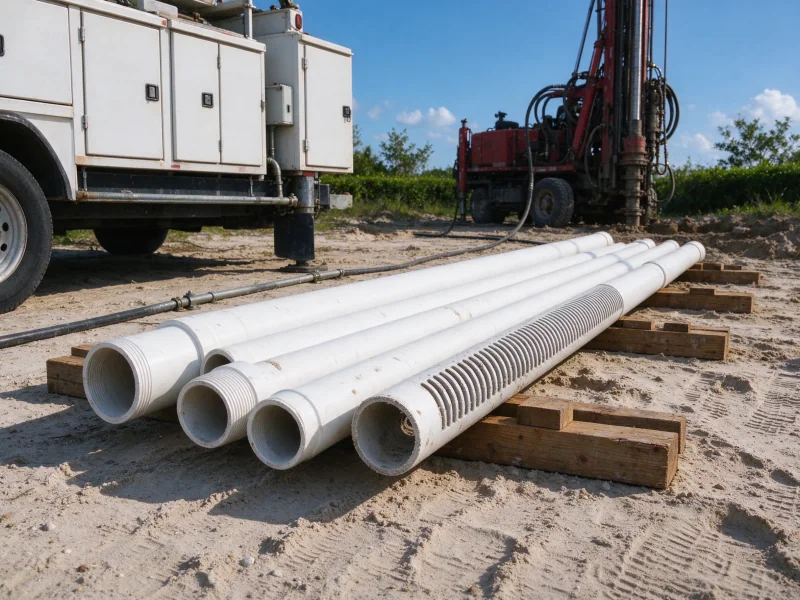
- Setting casing to the designed depth, with a screen where the design calls for one.
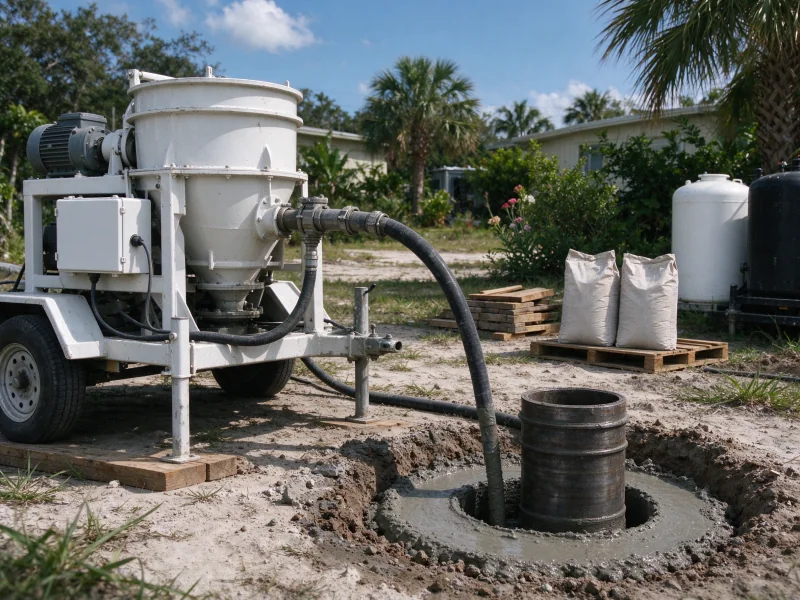
- Grouting the annular space between casing and borehole from bottom to top.
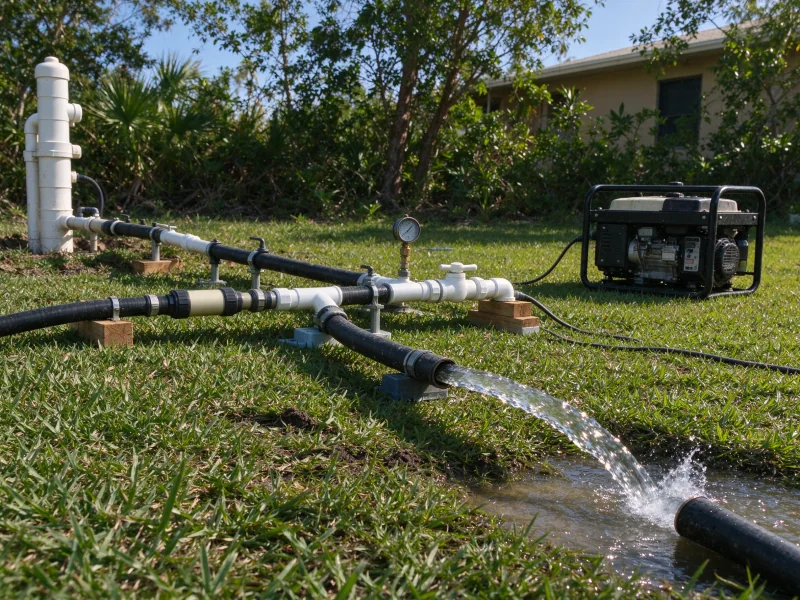
- Development by surging, jetting or airlifting to remove fines and drilling fluid so water enters the well freely.
- Yield and level testing: static water level, pumping water level, drawdown and recovery at a measured rate in gallons per minute.
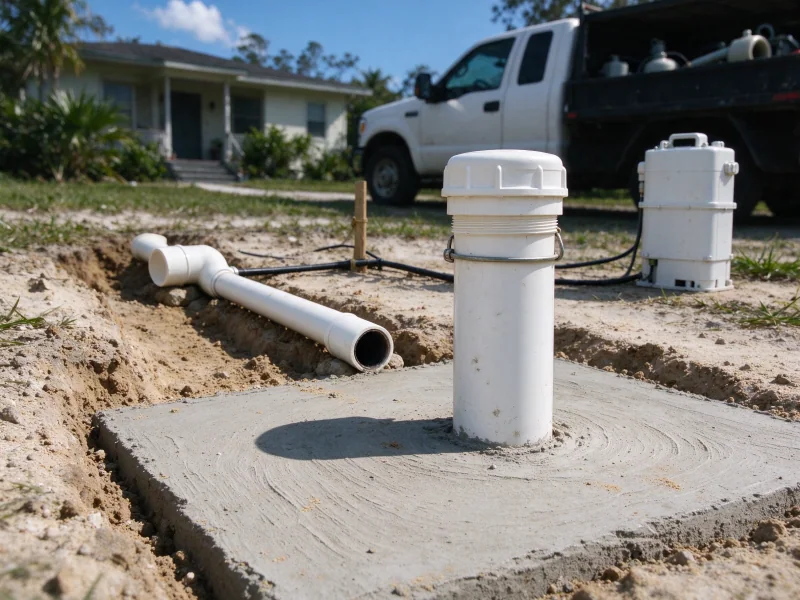
- Wellhead completion with a sanitary well cap at the required height, plus a pitless adapter where the buried line connects below grade.
- Pump system design based on the test results, then installation, disinfection and sampling.
- A well completion report recording depth, casing, grout and other construction details.
Casing, screen and the annular grout seal
Casing keeps the borehole open and keeps shallower water from running down the outside into the producing zone. Steel and PVC are both used for water well casing. The right choice depends on diameter, depth, formation conditions, water chemistry and the construction standards that apply, and the completion report should state what was actually installed. A well screen is used where the producing formation is loose material that would otherwise enter the well; its slot size has to match that formation.
The grout seal does the protective work. SJRWMD rule 40C-3.517 requires grout of Portland cement or natural bentonite slurry placed from the bottom up for the entire casing length. Casing under 4 inches gets a nominal one-inch seal of the annular space, and casing 4 inches or larger a nominal two-inch seal. The grout must set at least 12 hours before drilling continues. A poorly placed seal can leave a channel for surface water, which is why grouting is never treated as a step to rush.
Shallow surficial well or deeper aquifer
SJRWMD describes the surficial aquifer as a significant water source in Brevard. Surficial aquifers are generally less than 50 feet deep, and shallow wells under 50 feet are typically used for lawn irrigation. Intermediate aquifers, where present, are generally under 150 feet deep. In some areas the Floridan is a confined artesian aquifer with enough pressure that wells flow without a pump, a condition covered in our free-flowing artesian well guide.
Regional assessments describe the surficial and Floridan systems here as predominantly fresh to brackish, and water chemistry depends on which aquifer the well reaches. The target aquifer is therefore a design decision tied to use, demand and the water the property can expect. Our shallow vs deep well guide walks through those trade-offs in more detail.
Why depth and yield cannot be promised before drilling
No one can promise a specific depth, yield or water chemistry before the bore is drilled, because the formations under a lot are only known once they are encountered. Nearby well logs and regional studies help plan a target, but local layers, clay lenses and limestone conditions vary over short distances, so the estimate states the plan and how changes are handled.
This is also why the yield test comes before pump selection. If a well shows deep drawdown and slow recovery, a larger pump will only lower the water level faster; it cannot create more water. Our guide to pump trouble versus low well yield explains that relationship for existing wells, and the same logic applies to a new one. Groundwater levels also fluctuate, so a test describes the well on the day it was run.
Completing a new well installation
A finished well with no pump does not supply a house. New well installation adds the pump, drop pipe and wire, pressure tank, controls and the buried water line to the building. The pump is chosen from the tested pumping water level, the required flow and pressure, pipe length and the electrical supply. Deeper settings generally call for a submersible pump; some shallow suction wells use a surface jet pump. Our jet pump vs submersible guide compares the two.
The tank and controls are sized together so the pump does not short cycle. The pressure tank sizing guide explains that relationship, and later service is covered by well pump controls and pressure tank replacement. Trenching, the connection at the building and any electrical circuit work are separate line items performed by appropriately licensed contractors.
Drinking water wells and irrigation wells serve different jobs
A potable well is designed around sanitary protection, reliable household pressure and water that will be tested before anyone drinks it. An irrigation well is designed around flow for zones and run time, and it may target a shallower zone. The two can share a property but should not be confused, and an irrigation well is not a drinking water source just because the water looks clear. The irrigation well vs house water guide covers that split.
SJRWMD watering restrictions apply to private wells and pumps, so a new irrigation well does not exempt the lawn from watering days. Existing irrigation systems are handled through irrigation well pump repair; farm, nursery and business supply is planned on our commercial and agricultural wells page.
Why a per-foot drilling price is only part of the estimate
Searches for well drilling cost per foot are reasonable, but footage covers only the boring. A complete new well also includes casing, grout, development, testing, the wellhead, the pump package, trenching to the building and permits, and those items vary independently of depth. Comparing two quotes by their footage rate alone can hide large differences in what is included. A written estimate itemizes the drivers that apply:
- Drilling depth, geology and bore diameter.
- Casing length and material, and screen where the design needs one.
- Grout volume and seal requirements for the casing length.
- Rig access, mobilization and water or drilling-mud disposal.
- Development and yield testing.
- Pump depth and horsepower, drop pipe and wire length, tank and control package.
- Trenching to the building, electrical work, and permit and testing fees.
Water testing and records after the well is finished
Construction ends with a disinfected well, not a confirmed drinking water supply. Clear water does not establish safety; potability is shown by laboratory testing. Florida does not mandate routine private well sampling, but DOH-Brevard recommends coliform bacteria and nitrate testing every year and lead testing every three years for most homeowners. A first sample from a new well gives a baseline for later comparison, and our well water testing guide explains how to arrange it.
Keep the permit, completion report, final inspection record and pump details together. DOH-Brevard notes that the completion report is a different document from the site inspection and final, and newer permit records are searchable in ePermit. If the new well replaces an old one, the old well has to be dealt with too; see well abandonment. To start planning, use the contact page to describe the property, the intended use and any existing well.