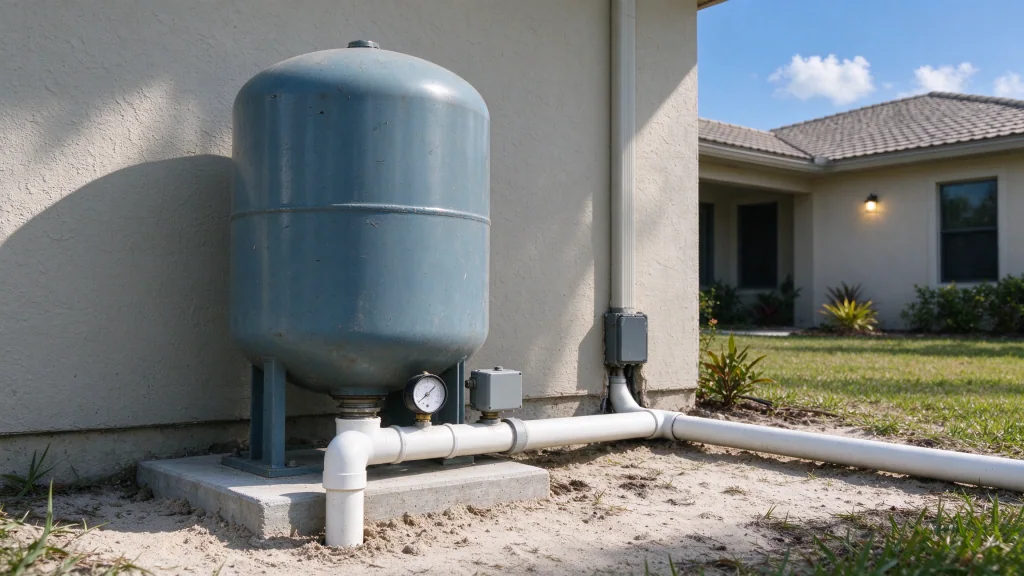
Choose by usable storage rather than the label
Coastal Palm Bay Well Pump Repair explains tank sizing in terms of drawdown: the water available between the system's stopping and starting pressure points. A tank's labeled capacity includes space that is not all delivered water. The compressed air and operating pressure range affect how much water can be drawn before the next pump start.
Two tanks with similar exterior dimensions are therefore not automatically interchangeable for a particular system. Manufacturer information for the actual model and operating conditions matters. A pressure tank replacement recommendation should explain usable storage and compatibility, rather than simply say that a larger shell is better. That distinction also prevents an unrealistic expectation that the entire nominal capacity will be available during an interruption.
Why usable drawdown affects pump starts
When water leaves the tank, the air cushion expands and system pressure falls. Once the control calls for the pump, water delivery replenishes the tank while also serving any continuing demand. More usable storage can increase the amount drawn between starts when the rest of the system is functioning appropriately. The pump and motor requirements still determine what operating pattern is suitable.
A tank that has lost its intended air cushion may behave as if it has very little storage. Frequent starts can then occur even though the labeled size has not changed. The short cycling guide explains why a condition check should precede a size change. Buying a larger tank without identifying a leak or a damaged control can leave the original cause in service.
Match tank selection to pump and controls
Tank selection belongs with the pump information and the control arrangement. The pump's delivery under the actual operating conditions, relevant motor guidance, and the intended starting and stopping points all influence usable drawdown and cycling. A system with different controls may need a different approach from a conventional pressure switch installation.
The well pump controls page describes why the installed arrangement needs to be identified before parts are selected. Precharge is also part of the relationship, but it is not a universal number to copy from another property. It must be checked and set according to the equipment instructions, with the water side in the required drained and isolated condition. A pressurized reading taken casually at the tank is not the same check.
Higher pressure changes the sizing question
Changing the control points changes the conditions under which the tank stores and delivers water. It can alter usable drawdown and the work required from the pump. A proposed tank replacement should therefore use the intended operating settings, not a capacity assumption taken from a label or an unrelated system.
The pressure switch settings guide explains why pressure adjustment needs to respect pump capability and system limits. If the pump cannot reach the selected stopping point, a new tank will not make it do so. If a fixture is weak because of a restriction, higher pressure may leave the restriction unresolved. The pressure versus flow guide explains what should be measured before treating stronger pressure as the answer.
A tank does not increase well yield
Well yield describes the supply available from the well under the relevant conditions. Tank drawdown describes stored water in the pressure system. They are related to the experience of water use, but they are different quantities. A larger pressure tank may change when the pump starts without making the well replenish faster.
If demand exceeds source delivery for a sustained period, the source question still needs an answer. The pump or low-yield guide explains how pumping levels and recovery help establish that limitation. Pressure tank sizing should not be presented as a substitute for that investigation. Additional storage arrangements, where appropriate, require their own design rather than assuming an oversized pressure tank solves every supply issue.
Include the installation conditions in the recommendation
A suitable replacement also has to fit the physical installation and its supported connections. Access, space, existing piping condition, serviceability, and appropriate protection of the equipment affect the practical scope. A corroded connection or an unresolved leak deserves attention in the estimate because the new tank will depend on that same delivery path.
Ask whether the recommendation includes the checks needed to establish the cause of the current complaint. If pressure falls with no intended water use, the system may be losing water through piping or a valve. If the motor never stops, the constant running guide explains another diagnostic path. Neither pattern should be reduced to a tank size calculation without supporting evidence.
What to ask before approving a tank
Ask for the proposed model, the operating assumptions used to choose it, and why its usable drawdown suits the pump and demand pattern. Ask whether the existing tank failed a condition check or whether the purpose is to change the cycling pattern of an otherwise sound system. Those are different reasons for work and should be described clearly.
A well system inspection can establish missing equipment details before selection. Keep available pump labels, control information, and prior service records for the discussion. After installation, the system should be evaluated through an appropriate operating cycle so pressure response and pump operation agree. The goal is compatible usable storage and reliable delivery, rather than the largest tank that fits the available space.