Wells that supply a business, farm or multi-building site
Coastal Palm Bay Well Pump Repair offers commercial and agricultural well services for properties in Palm Bay and the surrounding parts of south Brevard County. That includes new wells for pasture and livestock watering, nursery and crop irrigation, and supply to a small business or a property with several buildings, along with service on existing systems of that kind. Well construction, repair and abandonment are performed by a Florida-licensed water well contractor, and pump, electrical and plumbing work by appropriately licensed and insured contractors.
The same physical parts appear on a farm well and a house well: casing, grout seal, pump, controls and storage. What changes is the load placed on them, the consequences of downtime and the paperwork around them. A house that loses water is inconvenienced; a nursery or a trough line in summer can lose stock. Design therefore works backward from demand and from what happens if the supply stops.
How commercial and agricultural work differs from residential
Residential projects weigh occupied-home protection, lawn restoration and neighbor impacts. Commercial and agricultural projects add other constraints. Access often has to be scheduled around business hours, deliveries, animals or field operations. Site safety covers staff, customers and equipment moving near an open bore. Documentation is heavier, since owners, managers, insurers or lenders may want design records, test results and maintenance logs.
Larger systems may need an engineered design or drawings, and equipment such as large pumps, motors, drives and storage tanks may involve procurement lead times. Larger drilling and pump-setting equipment also needs firm access and space to stage. None of this changes the order of construction described on our well drilling page; it changes the planning around it and how much of it has to be written down.
Start with peak demand, daily volume and storage
The first design question is how much water the site needs at its busiest moment and over a full day. Peak demand in gallons per minute decides pump and pipe size; daily volume and run time decide whether the well can keep up over hours rather than minutes. A greenhouse misting cycle, several irrigation zones and a wash station starting together create a very different peak than the same uses spread through the day.
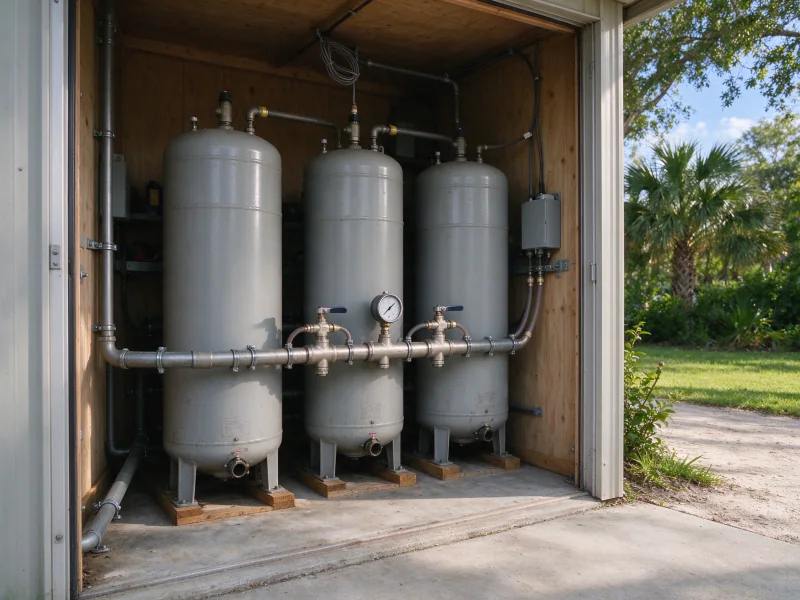
Storage changes the equation. A storage tank filled slowly from a modest well and then pumped out by a booster can meet short peaks the well could not supply directly. Multiple pumps, or a primary and backup pump, can cover redundancy for operations that cannot go dry. The useful inputs are a list of every use, how many run at once, how long each runs, seasonal changes such as summer stocking or crop cycles, and any future expansion.
- Peak flow: every fixture, zone, trough or process that can run at the same time.
- Daily and seasonal volume: total gallons and the busiest season.
- Run time and duty: how many hours the pump will run on a heavy day.
- Storage and redundancy: what must keep running if one pump or the well is down.
- Water use: drinking, process, irrigation or animal watering, since each carries different protection needs.
Permits for larger-diameter and higher-volume wells
Well diameter changes the permitting office. In Brevard, DOH-Brevard permits wells under 6 inches in diameter outside delineated areas, while the St. Johns River Water Management District permits wells 6 inches or larger and all wells in delineated areas. Many commercial and agricultural wells fall into the larger-diameter group. Applications go through the District's ePermit system, and wells are built under Chapters 40C-3 and 62-532 of the Florida Administrative Code, with setbacks to hazards following Table 1 of Chapter 62-532.
Construction permits are not the only question. An agricultural operation or another large withdrawal may require a water use permit from the District; that is confirmed before design, because it can affect the well's size, the target aquifer and the pumping plan. The shallow vs deep well guide explains how aquifer choice affects supply and water chemistry. A well permit also does not relieve the owner of county, municipal, utility, drainage-easement or reclaimed-water requirements. Our Florida well permit guide explains the difference between equipment work and well construction.
Pump, storage and control options for larger systems
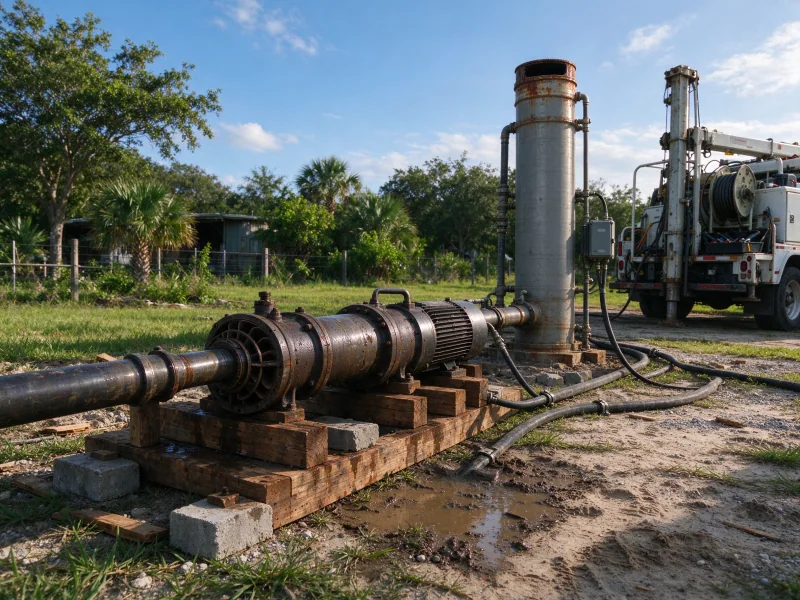
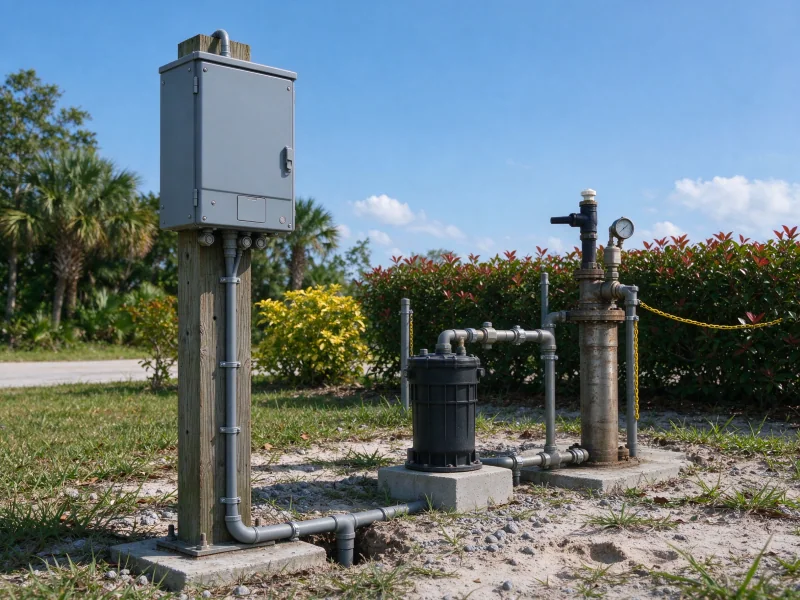
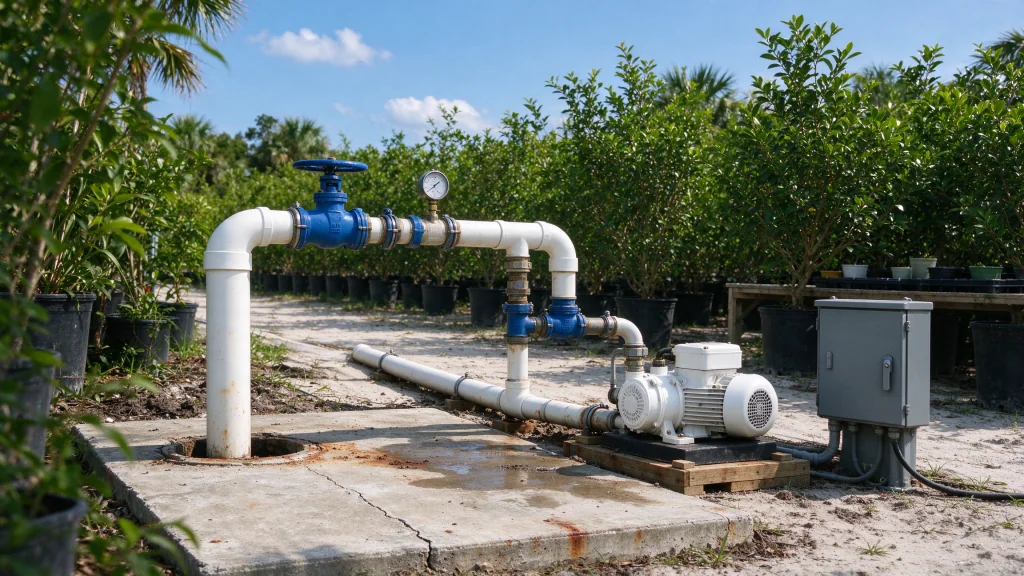
Larger systems use a wider range of equipment than a typical house. A submersible turbine pump sets deep in the well for higher flows; a centrifugal pump can move large volumes from a storage tank or a shallow source; a booster system raises pressure after storage. Variable speed control, one of the options covered under well pump controls, can hold a steady pressure as demand rises and falls, which suits sites where uses start and stop unpredictably. Selection follows the test results and the demand list, not the other way around.
The well sets the ceiling. If a test shows heavy drawdown and slow recovery at the required rate, a bigger pump will lower the water level faster and can pull sediment without adding water. The answer may be storage, a second well, or a demand schedule. Our guide to pump trouble versus low well yield explains that limit, and pressure vs flow explains why high pressure at the tank does not mean the system can deliver the gallons a site needs.
Livestock, pasture and nursery irrigation supply
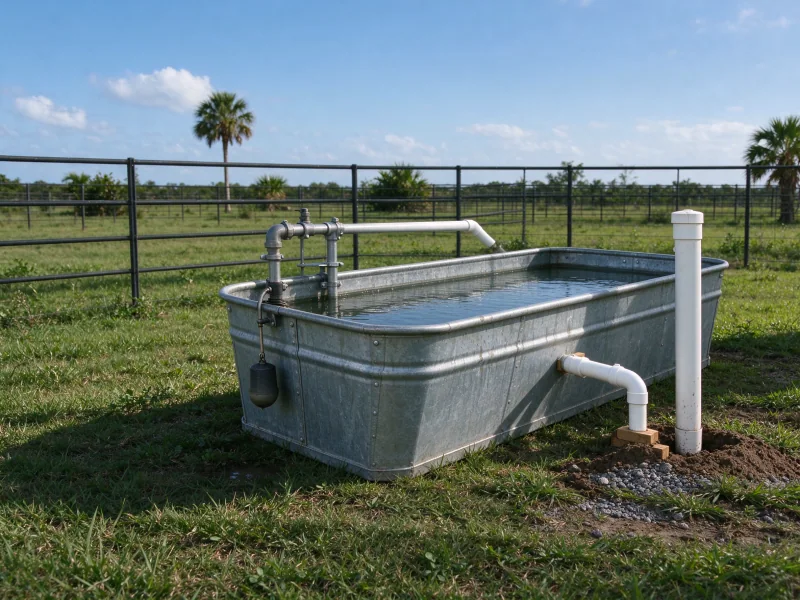
Pasture and livestock wells usually feed trough lines or float-valve tanks spread across a property, so pipe runs are long and exposed piping has to be protected from sun and animal damage. Nursery and crop irrigation tends to need larger flow for set periods, and drip or micro-irrigation equipment may set its own pressure and filtration needs, which the irrigation designer specifies. Planning maps the distances and elevations so pressure at the far end of the line is accounted for.
SJRWMD watering restrictions apply to private wells and pumps, so owning the well does not exempt landscape irrigation from watering rules. Keeping irrigation and potable supplies distinct is explained in the irrigation well vs house water guide. Where agricultural withdrawals fall under District water use permitting, that permit sets its own conditions. Rural land in Malabar and Grant-Valkaria is described in local plans as residential with private wells and septic, so an agricultural well may sit on the same parcel as a household well and septic system, which makes placement and setbacks important. Existing pump problems on irrigation systems are handled through irrigation well pump repair.
When the well serves employees, customers or the public
A well that supplies drinking water to the public can fall under different drinking water rules than a private household well. That classification depends on the use, the number of people served and how the system is connected, and it is confirmed with the responsible agency before design, because it can change construction, treatment, testing and reporting obligations.
Where a well serves both potable and non-potable uses, or connects to irrigation, chemical injection or animal watering equipment, backflow protection may be required to keep that water out of the drinking supply; the requirement depends on the connection and local rules. Clear water still does not prove potability. Laboratory testing does, and DOH-Brevard recommends coliform and nitrate testing every year for private wells. Our water testing guide explains how to approach sampling after construction or repair.
Service on existing commercial and agricultural wells
Not every project starts with a new bore. Existing systems may need pump or control repair, a storage or pressure tank, or a closer look at a well that is losing capacity. A falling specific capacity, meaning fewer gallons per minute for each foot of drawdown, can point toward encrustation, biofouling or sediment that well rehabilitation can address, while damaged casing or a source that no longer meets demand may point to a replacement well and abandonment of the old one.
A well system inspection can document the present condition before decisions are made. Repair of the well below ground is licensed water well work, and where groundwater protection requires it, permission is obtained before the well is repaired. Pump replacement on a sound well is equipment work, covered on our well pump replacement page.
Records and maintenance schedules that protect uptime
A commercial well is easier to manage when its baseline is written down. Keep the completion report with depth, casing and grout details, the original test with static level, pumping level and drawdown at a stated flow, pump and motor data, control settings and the permit and final inspection records. Later readings mean something only when they can be compared with that baseline.
A maintenance schedule records water levels, flow, pressure, run hours and electrical readings at intervals the owner agrees with the contractor, along with sampling results. Trends catch decline before an outage. Our well pump maintenance page describes what routine service can and cannot reveal, and the same records help support any permit reporting a water use permit requires.
What drives a commercial or agricultural well estimate
Larger wells change several cost drivers at once. A written estimate itemizes the ones that apply: drilling depth, geology and bore diameter; casing length and material; screen where the design needs one; grout and seal requirements; rig access and mobilization; water and drilling-mud disposal; development and yield testing; pump depth and horsepower; drop pipe and wire length; storage, tank and control package; trenching and pipe runs across the site; electrical work; engineering where required; and permit and testing fees.
To begin, use the contact page to describe the property, each intended use, the number of buildings or animals served, any existing well records and the timeline. That information lets the first conversation focus on demand and permitting rather than on a pump size picked in advance.