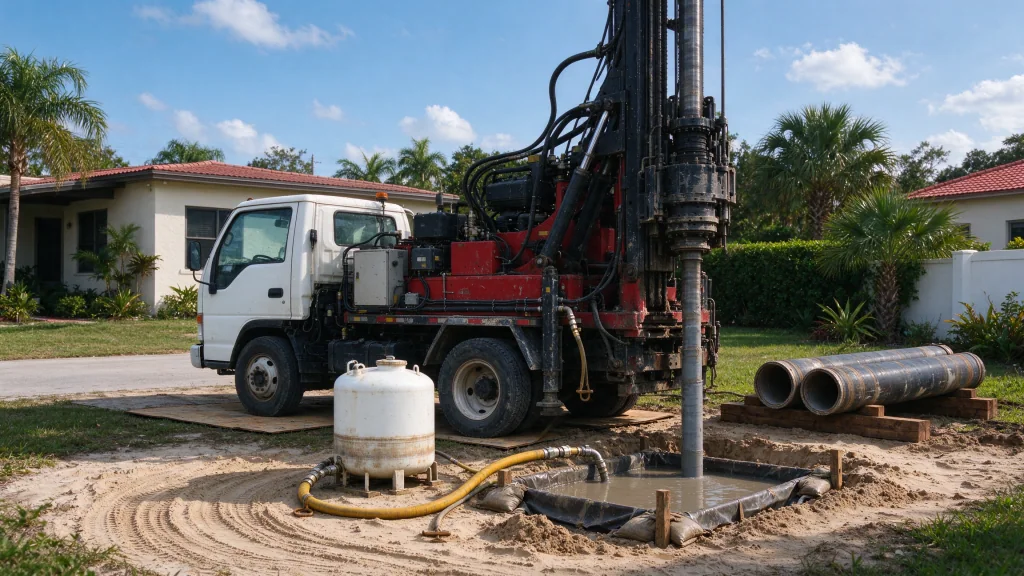
Is a shallow or a deep well the better choice?
Neither is better in every case. A shallow well draws from the surficial aquifer and often suits lawn irrigation; a deeper well reaches an intermediate or Floridan zone and may suit household supply or higher demand. The right depth depends on the water's use, required flow, the aquifer's chemistry and what the parcel's permits allow.
Coastal Palm Bay Well Pump Repair offers well drilling for Palm Bay properties, with construction performed by a Florida-licensed water well contractor. This guide explains the trade-offs so the depth question is tied to the job the well will do, not to a single number. No depth, yield or water chemistry can be promised before a bore is drilled.
The aquifers a Brevard well can draw from
The St. Johns River Water Management District describes the surficial aquifer as a significant water source in Brevard County. Surficial aquifers are generally less than 50 feet deep, and the District notes that shallow wells under 50 feet are typically used for lawn irrigation. Below that, intermediate aquifers, where present, are generally less than 150 feet deep.
Deeper still, the Floridan is a confined artesian aquifer in some areas, meaning water is held under pressure beneath confining layers. Whether an intermediate zone exists under a particular lot, and how deep the Floridan sits there, is a site question answered by nearby well logs during planning and confirmed only by drilling. A shallow and a deep well are therefore often drawing from separate water sources, not just different points in the same one.
Pump types change with the water level
The pumping water level, not the total depth of the well, decides which pump will work. A surface jet pump lifts water by suction, and suction has a practical lift limit, so jet pumps are found on shallow wells where the water stays near the surface. Some jet systems on deeper wells push water down to an ejector in the well to extend that reach. Submersible pumps sit below the water and push it up, which suits deeper settings and larger flows.
Our jet pump vs submersible guide compares the two in detail. On an existing shallow system, losing prime and drawing air are common complaints; see jet pump repair and why a jet pump loses prime. Deeper systems depend on a pitless adapter, drop pipe and wire, and service on them is covered under submersible well pump repair.
How shallow and deep wells respond to dry weather
Groundwater levels fluctuate, and SJRWMD's drought guidance for well owners is built around that fact. A shallow surficial well sits close to the water table, which rises and falls with rainfall, evaporation and nearby pumping. When the static water level drops, a suction pump may approach its lift limit, and the drawdown during a long irrigation cycle can bring the water to the intake sooner than it did in a wet month.
A deeper confined aquifer is buffered from the surface in a different way, but it is not immune to change, and pressure and levels still vary. Weak delivery in a dry spell is not automatic proof the well is too shallow; a worn pump, a suction leak or a control fault can look similar. Our guide to pump trouble versus low well yield separates those causes before anyone talks about a new well.
Water chemistry depends on the aquifer reached
A District assessment covering Brevard describes the surficial and Floridan systems in the area as predominantly fresh to brackish, with brackish meaning 1,000 to 10,000 mg/L of total dissolved solids. Which aquifer the well reaches largely decides what is in the water, so drilling deeper can change mineral content or salinity in either direction depending on location.
Some wells produce water with iron, which stains fixtures and can feed iron bacteria, or hydrogen sulfide, which gives a rotten-egg odor. Where either occurs, it is a property of the water reached and is confirmed by testing rather than predicted from depth. A shallow well sits closer to surface influences, which makes the grout seal and wellhead protection especially important. Iron and sulfur staining are separate from sand and sediment problems, which point to the well's construction or development.
Artesian pressure in deeper wells
In parts of the District, artesian pressure in the Floridan is high enough that wells flow at the surface without a pump. A flowing well brings its own responsibilities: under Florida Statutes section 373.206 the owner must provide a valve that can control the discharge and keep it set so only the water needed for ordinary use flows. Our free-flowing artesian well guide explains control valves, plugging and the District's program for eligible abandoned artesian wells.
Irrigation, drinking water and well diameter
Use changes the design more than depth alone. An irrigation well is built for flow during scheduled run times, and a shallow surficial well often fits that job. A drinking water well needs sanitary construction, dependable household pressure and laboratory testing before use. The two can share a lot, and our irrigation well vs house water guide explains how to keep them distinct.
Diameter matters as well. SJRWMD describes a 3- or 4-inch-diameter well adequately equipped with a pump as the ideal well for most homeowners. Diameter also sets the permit path: DOH-Brevard permits wells under 6 inches outside delineated areas, and the District permits wells 6 inches or larger and all wells in delineated areas, through its ePermit system. The Florida well permit guide covers that boundary. A wider casing allows a larger pump; it does not make the aquifer give more water.
Side-by-side comparison
These are general tendencies, not predictions for a specific lot. The test results and laboratory sample from the actual well settle each point.
- Source: shallow wells draw from the surficial aquifer, generally under 50 feet; deeper wells reach intermediate zones, where present, or the Floridan.
- Typical use: shallow wells under 50 feet are typically used for lawn irrigation; household supply is designed around sanitary protection and testing whatever the depth.
- Pump: shallow suction wells may use a jet pump; deeper water levels generally call for a submersible.
- Dry weather: shallow wells follow water-table changes more closely; all groundwater levels fluctuate.
- Chemistry: fresh to brackish in both systems; depends on the aquifer reached and is confirmed by testing.
- Pressure: some Floridan wells are artesian and may flow without a pump, which brings a legal duty to control the flow.
- Cost: deeper wells add footage, casing and grout; the pump package, trenching and permits apply to both.
Deciding for your property
Bring three things to the conversation: what the water will be used for, the flow and daily volume needed, and any records from existing wells on or near the lot. If the decision is part of a home purchase, the private-well homebuyer guide lists the records worth requesting. For a farm or business supply, the commercial and agricultural wells page explains demand planning. When you are ready, use the contact page to describe the property and the intended use.