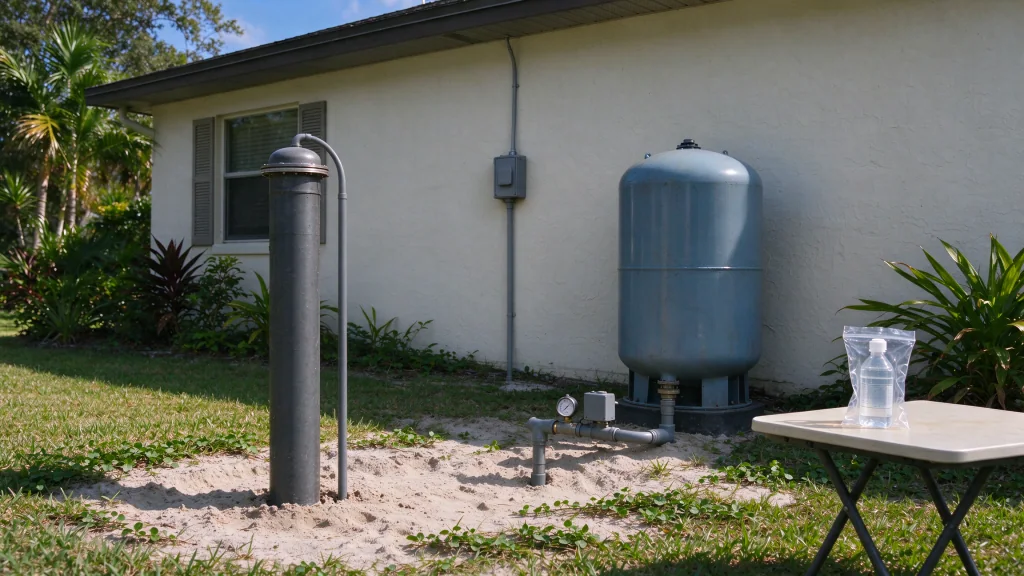
Start by describing what is actually present
Coastal Palm Bay Well Pump Repair separates visible particles from changes in color and air cloudiness. Grit collecting in an aerator, fine material settling in a container, and water that looks colored without settling are different observations. None is a reliable substitute for material identification or water testing when a health question is involved.
Note whether material appears at all fixtures, only on one branch, after the pump first starts, or after a long period of use. Recent plumbing work may disturb material already inside the system. Persistent sediment that returns after that disturbance has cleared needs a broader explanation. A well system inspection can connect the material pattern to the installed pump, pipe arrangement, and available well records.
How well construction and pumping conditions can matter
The source formation, screen where present, casing condition, and position of the pump or intake can affect whether particles enter the water being pumped. A defect or a change in conditions can allow material to move into the system. Different well constructions need different interpretations, so a technician should not assume a screened well or a particular formation from the property address.
Pump position is relevant, but moving the pump is not automatically the correct solution. The completed well depth, intake setting, and water levels need to be understood together. The well yield guide explains why these measurements describe separate things. An intake position that changes sediment pickup still needs to provide a suitable water supply under actual pumping conditions.
What timing can reveal
Material that appears after extended pumping may justify looking at how the source responds as water is withdrawn. Sediment immediately after equipment retrieval or pipe work may reflect disturbance. Neither pattern proves a single cause. The value of the observation is that it helps the technician reproduce or measure the condition without treating every particle complaint as the same job.
Avoid deliberately running the well for a long period to see how much sediment it can produce. A pump operating with poor supply or abrasive material may face additional stress. Record ordinary use instead. If pressure also changes, the pressure versus flow guide helps distinguish a restriction in the delivery path from an inability to provide enough water at the source.
A filter can protect a fixture without correcting the cause
A particle filter can collect material in the water passing through it, but collecting sediment does not establish whether the source is stable. Frequent loading can also restrict delivery, causing a pressure drop under use even when pressure upstream appears satisfactory. A clogged filter and an underlying sediment problem can therefore be present at the same time.
The low water pressure page explains why restrictions need to be checked before blaming pump capacity. Do not remove or bypass water treatment equipment without understanding its purpose and the water quality implications. Treatment installation is not a service we offer. The pump investigation should identify the source concern and explain when another qualified service or appropriate water testing is needed.
When a pump repair is only part of the answer
A pump can be damaged or lose performance while sediment is also entering from a separate well issue. Replacing worn equipment may restore delivery temporarily without changing the source of particles. Ask whether the findings support a pump component problem, a pipe problem, or a concern with the well itself. Those are different scopes and may require different specialists.
The submersible pump repair page describes why access and retrieval may be part of diagnosis. The repair or replace guide helps evaluate an equipment recommendation once the cause is clearer. Pump work does not automatically include well rehabilitation or drilling; those are scoped from evidence about the screen and formation, and deepening and treatment installation are not offered. If findings point beyond pump work, that boundary should be clear before you approve the repair.
Keep the water quality question separate
Visible sediment cannot establish whether the water is microbiologically or chemically safe. Clear water cannot establish that either. Brevard guidance recommends annual coliform and nitrate testing for private wells. A sudden water change, flood event, or repair that opens the system may also warrant guidance tailored to the event rather than a visual judgment at a faucet.
The water testing after pump repair guide explains that distinction. Bring available well records, prior test results, and a description of recent work to the discussion. The goal of a maintenance review is to document changes and equipment condition, while the laboratory and appropriate water quality advice answer a separate safety question.
What to ask before approving work
Ask what evidence identifies the particle source, what part of the system the proposed work changes, and what observation will show improvement. An estimate that only names a replacement pump leaves the causal question open. An explanation that distinguishes sediment entry from its effect on equipment gives you a clearer way to judge the proposed scope.
Also ask what remains uncertain until access is obtained. A staged inspection can be reasonable when records are incomplete, provided the next decision is explained. The replacement process guide describes why access findings can change equipment scope. Keep those findings connected to the sediment complaint rather than accepting improved pressure as proof that particle entry has stopped.