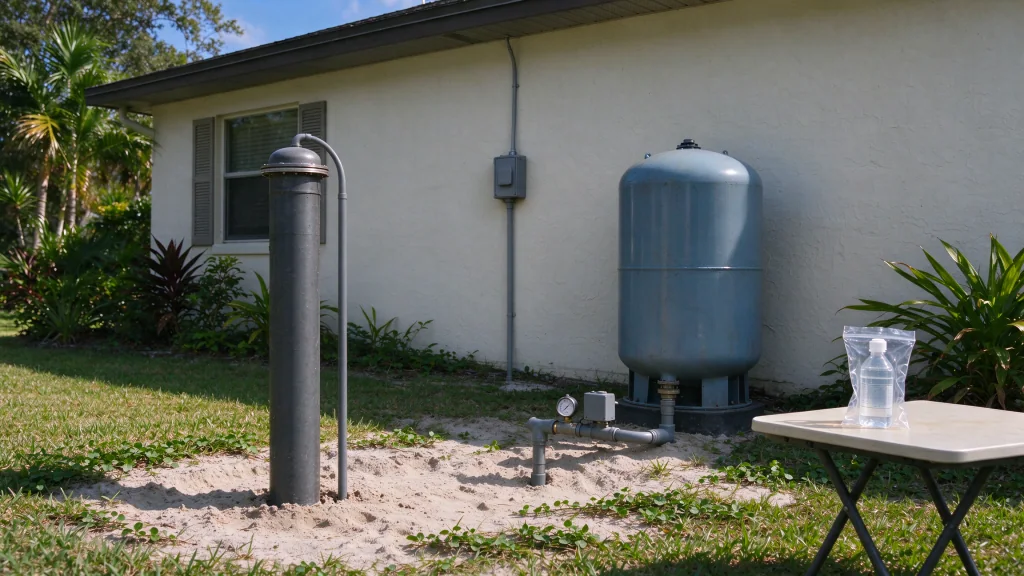
Pump operation does not establish potability
Water testing after pump repair depends on the work performed, the well's condition and any contamination concern. Restored pressure does not prove the water is safe to drink. Coastal Palm Bay Well Pump Repair recommends keeping mechanical commissioning separate from laboratory sampling and following the health department's guidance when the well has been opened or flooded.
A pressure switch repair above ground creates a different situation from work that opens the well or replaces a submerged pump. Ask what was disturbed and whether the contractor identified a sanitary concern. The replacement process guide explains why the scope of work matters. A test should answer a defined question, with an appropriate sample, rather than serve as a vague promise that everything is fine.
Choose health tests for the actual concern
DOH-Brevard recommends annual coliform bacteria and nitrate testing for private wells, with lead testing every three years for most homeowners. Its guidance also distinguishes that recommendation from state-mandated routine sampling, which is not required for ordinary private home wells. Use the county private-well guidance to discuss the right testing plan with a laboratory or public-health professional.
Total coliform testing is used as an indicator of sanitary conditions. E. coli has a more specific fecal-contamination significance. Nitrate is a separate chemical concern and is not ruled out by a negative bacteria result. Arsenic is another distinct analyte that may belong in a site-specific test panel. A single test does not cover every contaminant. Explain any known property history or suspected exposure so the panel fits the question rather than assuming a standard package proves universal safety.
Mineral tests and appearance measurements have other jobs
Iron and manganese can be relevant to staining and treatment assessment. Hardness can guide a water-softening evaluation. Hydrogen sulfide can be relevant when investigating a sulfur-like odor. None of those symptoms identifies the complete composition of the water, and a smell or stain should not be used to diagnose a health contaminant without testing.
Water pH, turbidity and total dissolved solids describe different characteristics. Turbidity concerns suspended material and cloudiness; total dissolved solids concerns dissolved constituents and does not identify each one. An acceptable reading for one parameter does not establish that bacteria or another untested contaminant is absent. The sediment guide and air in water guide help distinguish visible symptoms from conclusions that require analysis.
A rotten-egg smell is a clue, not a test result
A sulfur or rotten-egg odor usually means hydrogen sulfide is present somewhere between the aquifer and the faucet, and where it shows up narrows the search. If the smell appears only in hot water, the water heater is a likely place for it to form. If it is in hot and cold water alike, the groundwater or the well is the more likely source. Sulfur-reducing bacteria in a well or plumbing can also produce the gas. The odor does not tell you whether the water carries bacteria of health concern, so it is not a substitute for a coliform and E. coli test.
A smell that appears suddenly after flooding, after the well was opened for repair or after a change in the water's color deserves a bacteriological test before anyone assumes it is a harmless mineral issue. Persistent odor from the aquifer itself is a water-quality question. Selecting treatment equipment is outside the services we offer, but a well whose output is also declining or turning cloudy may point to a fouled screen or iron bacteria, which well rehabilitation addresses. Brevard's aquifers range from fresh to brackish, as the shallow versus deep well guide explains, so the aquifer a well draws from can affect what the water carries.
A contamination result needs a source investigation
A bacterial concern can call for assessment of the wellhead, cap, seals and possible entry pathways, along with professional disinfection evaluation and follow-up testing. Treating the water once without considering how contamination entered may leave the cause in place. Structural well work has a different scope from pump repair; see the Florida permitting guide when casing or other well construction is involved.
Flood exposure requires particular care. Florida public-health guidance explains that flooded wells may need disinfection and testing once floodwater recedes. Do not infer safety because the pump restarts after an outage. The storm and power-outage guide separates electrical recovery from this water-quality decision. Follow official instructions on water use while the concern is being resolved rather than improvising chemical quantities.
Arrange the sample before collecting water
Ask the laboratory which containers, sample location, handling method and delivery timing apply to the requested analyses. Sampling requirements differ, and a reused household bottle is not a substitute for the specified container. If disinfection, flushing or treatment changes have occurred, tell the laboratory before collection so it can advise on timing and interpretation.
Keep the laboratory report, sample date, location and relevant repair record together. A result represents the sampled water under the stated conditions, not a lifetime guarantee. A well system inspection can document equipment and visible conditions, but it does not replace laboratory water analysis. During a home purchase, the private-well buying guide helps keep operational testing and water sampling as distinct inspection tasks.
Use results to select the next specialist
Treatment selection should follow the identified water characteristics. Iron and manganese may lead to filtration assessment; hardness may lead to a softening discussion. Sediment can require investigation of its source as well as evaluation of a sediment filter. A filter that catches particles does not necessarily remove dissolved contaminants or correct a damaged well.
For dissolved contaminants, the treatment method must be suited to the specific laboratory findings and intended use. Bacterial contamination may require source correction and disinfection evaluation rather than a generic equipment purchase. We focus on existing well pump repair. Treatment installation requires a separately qualified assessment and scope. If low pressure also exists, diagnose that hydraulic issue without treating a pressure improvement as proof that the water-quality concern has been solved.