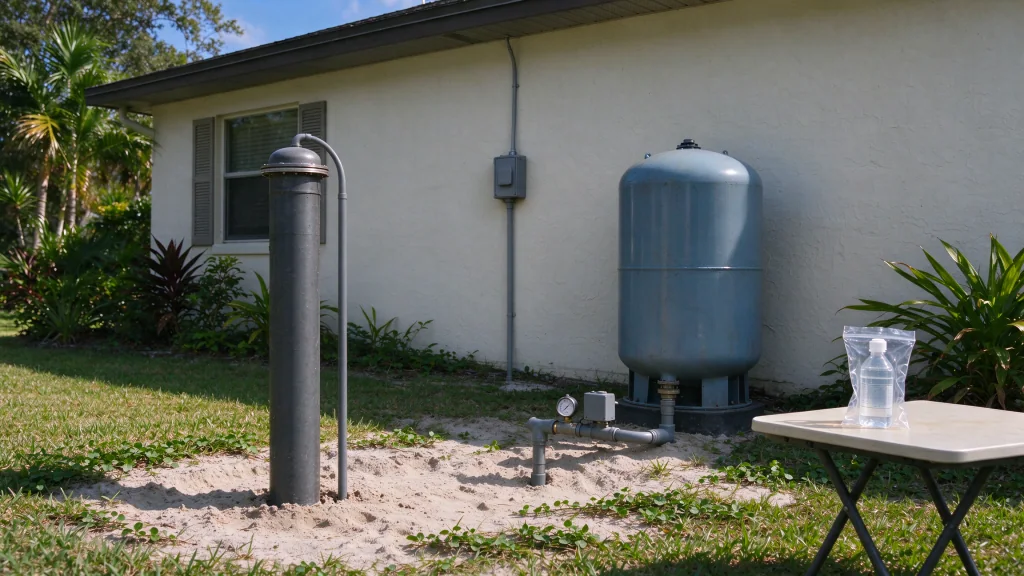
Arrange three distinct lines of inquiry
Before buying a private-well home, review the well records, assess equipment operation and arrange appropriate laboratory water testing. Each answers a different question. Coastal Palm Bay Well Pump Repair recommends confirming the inspection scope early so a brief pump run is not mistaken for proof of seasonal supply or drinking-water safety.
Start by establishing whether the well serves the house, irrigation or both. A visible pump does not prove the indoor plumbing uses that source. The irrigation versus house water guide helps separate those arrangements. This affects which equipment needs assessment and which water must be sampled for the purchase.
Ask for records before the visit
Useful records include the well completion report, available permit documents, pump and tank invoices, prior repair details and laboratory results. The completion record may establish recorded construction details, while a service invoice can identify more recent equipment. Neither should be assumed to describe every current condition without comparison at the property.
Ask the seller about interruptions, sediment, pressure changes and any known contamination concern. Treat that history as information to verify, not a substitute for inspection. The Florida permit guide explains why structural well work and pump equipment are different subjects. Missing records should be listed as an uncertainty rather than filled in with a neighboring property's depth or pump specification.
Define the operational assessment
An operational assessment can document accessible equipment, visible condition and how the system performs under stated test conditions. It may include observed starting, delivery, pressure behavior and cycling. Ask what the inspection includes, how long the system will be observed and which inaccessible or concealed components remain outside the assessment.
A well system inspection should distinguish equipment findings from source performance. Short cycling may point toward tank or control concerns; weak delivery can involve a restriction, pump problem or source limitation. The pressure versus flow guide explains why a pressure gauge alone cannot establish how much usable water is available at a fixture.
A short run cannot guarantee seasonal supply
Yield and recovery describe how the source responds to withdrawal over time. A pump that delivers water during a brief visit has passed only the conditions observed in that visit. The test does not establish every future irrigation demand, occupancy pattern or dry-weather water level. Ask whether a separate performance or recovery assessment is appropriate for the property.
The pump versus low-yield guide explains the distinction between equipment capacity and available water. Static water level, pumping water level, pump setting and completed well depth are different facts. A promise based only on motor horsepower or the depth shown on a record leaves important questions unanswered.
Water quality needs its own scope and sample
Arrange the laboratory panel and sampling procedure before collecting water. A bacterial test, nitrate test and mineral analysis address different questions. The lender, contract or intended use may create additional requirements that should be confirmed with the appropriate party. Do not assume a generic package covers every property-specific concern.
DOH-Brevard recommends annual coliform bacteria and nitrate testing, with lead testing every three years for most homeowners. The water-testing guide explains that recommendation and the limits of appearance and taste. Prior laboratory results are useful history, but they do not replace a current sample when one is needed for the transaction. A negative result for one analyte does not clear untested contaminants.
Turn findings into a defined purchase decision
Request a written summary that separates observed defects, recommended work and uncertainties. If replacement is suggested, ask whether the evidence points to the pump, tank or controls and whether the source can support the planned demand. The repair-or-replace guide helps frame those equipment decisions without treating age alone as failure.
For budgeting, obtain a property-specific scope rather than relying on an unsupported local average. The repair cost guide explains the drivers and limits of examples. If work is negotiated, identify who will authorize it, what documents will be provided and whether follow-up operating checks or laboratory sampling are included before considering the issue resolved.