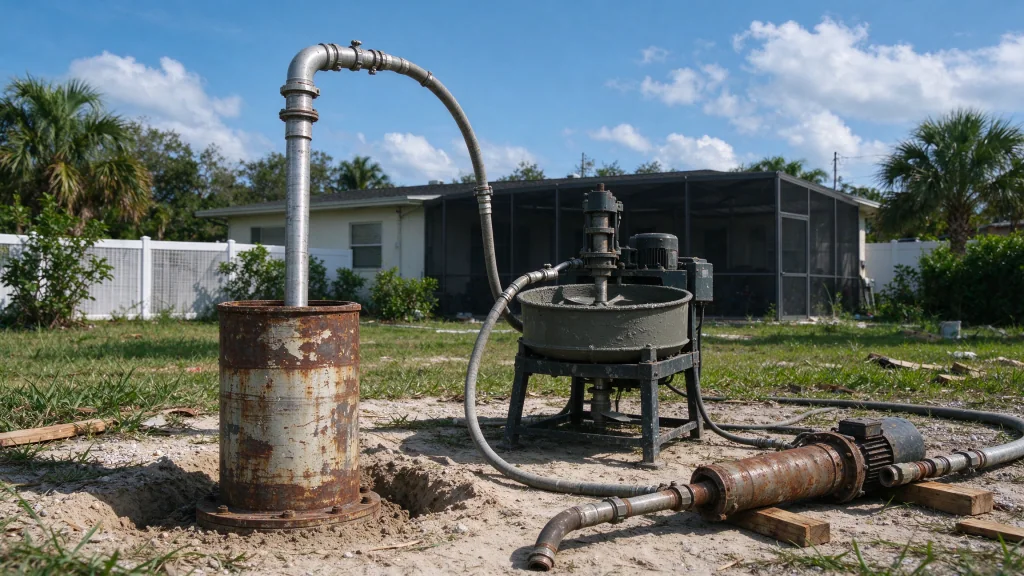
What is a free-flowing artesian well?
An artesian well taps a confined aquifer, where water is held under pressure beneath a less permeable layer. Once the casing breaks through that layer, the pressure pushes water up the well. When the pressure is high enough to lift water above the ground surface, the well flows on its own with no pump, and it is called free-flowing.
Coastal Palm Bay Well Pump Repair offers well abandonment and well repair through Florida-licensed water well contractors, and this guide explains the choices an owner faces when an old well on the property will not stop running. An old flowing well may have been drilled for irrigation or livestock and later left open, so the current owner may not know when or why it was built.
Why some wells in the District flow without a pump
The St. Johns River Water Management District describes the Floridan aquifer as a confined artesian aquifer in some areas, and notes that in parts of the District the artesian pressure is high enough for wells to flow without a pump. Shallower surficial wells, which the District describes as generally less than 50 feet deep, do not behave this way, because the surficial aquifer is not confined. Our shallow vs deep well guide explains the difference.
Whether a particular well in south Brevard flows depends on the aquifer it reaches, the elevation of the ground at the wellhead and groundwater levels, which fluctuate. Two wells on similar lots can behave differently. A well that flows only part of the year is still an artesian well; its pressure is simply close to the ground surface.
Why a continuously flowing well is a problem
The most obvious issue is waste. Water that runs day and night into a ditch or pasture is drawn from an aquifer that many users depend on, and the lost pressure can reduce what is available to other wells drawing from the same zone. The District's assessment of the area describes the surficial and Floridan systems as predominantly fresh to brackish, with brackish meaning 1,000 to 10,000 mg/L total dissolved solids. Where an artesian well carries mineralized water, a constant discharge can spread it across soil and into surface water.
Old wells also deteriorate, and like any wellhead they are exposed to runoff; our guide to a well after flooding covers that risk. A corroded casing can leak below ground, letting pressurized water move into shallower zones or wash out soil around the casing. Soft or eroded ground near the wellhead is a sign the flow may be escaping outside the casing, and it can be unsafe to stand on. A well that leaks this way usually cannot be fixed by closing a valve at the top.
The owner's legal duty to control the flow
Florida Statutes section 373.206 requires the owner of a flowing artesian well to provide a valve capable of controlling the discharge, and to keep it set so that only the water needed for ordinary use flows. The same statute provides that a well whose water is poor enough to harm a drinking water source must be plugged to agency specifications.
In practical terms, an artesian well that is allowed to run freely without a working valve does not meet that duty, even if the flow has been running for years before the current owner bought the property. Responsibility follows ownership of the land.
Keep and control the well, or plug it
There are two broad paths. If the well is still useful, for irrigation or livestock for example, and its casing is sound, it can be fitted with a control valve and a secure well cap so it flows only when water is needed. Work on the casing and wellhead below ground is licensed well repair, performed by a Florida-licensed water well contractor, and where required to protect groundwater, prior permission is obtained first. Watering restrictions from the District also apply to private wells, so a well kept for irrigation is still used within those rules, and any pump added later is handled as irrigation well pump repair work; see our guide on irrigation wells versus house water.
If the well is no longer needed, is leaking around the casing or carries poor water, plugging is usually the right answer. When the property still needs a water source, well drilling can provide a properly sealed replacement before the old well is plugged. Abandoned artesian wells are plugged by a licensed water well contractor after a request on the State of Florida permit application form, using Portland cement or natural bentonite slurry placed from the bottom to the top. The casing seat is sealed with grout from 20 feet below the seat to the top of the well. Controlling the flow during that work is part of the job and one reason these wells need a licensed contractor.
How the SJRWMD free plugging program works
The St. Johns River Water Management District runs an Abandoned Artesian Well Plugging program that offers free well plugging for property owners with eligible abandoned artesian wells in its 18 counties. Brevard County lies entirely within the District. The District notes that paying privately typically costs several thousand dollars per well, so checking eligibility first is worthwhile.
- Gather what you know: the well's location, approximate diameter, how fast and how constantly it flows, and any well log or permit records
- Apply online through the District's report-a-well page
- Expect an inspector to contact you within 30 days to review the well
- If the well qualifies, the District arranges plugging under its program rules
- If it does not qualify, or you need a different schedule, a private abandonment through a licensed water well contractor is the alternative
What to do while the well waits
Until a valve is installed or the well is plugged, the aim is to avoid making it worse and to collect information that helps the contractor or inspector.
- Do not force a makeshift cap, plug or pipe fitting onto the casing; blocked pressure can find a path around a weak casing and break out underground
- Do not bury the well or push fill around it, which hides it and lets surface material reach the opening
- Keep people, pets and livestock away from soft or eroded ground near the wellhead
- Note the flow rate as best you can, whether it changes with the seasons, and any color, odor or staining
- Photograph the wellhead and the discharge path, and report the well to the District
Keep a record of the well and the work
Whichever path you choose, keep the permit, inspection and plugging documentation with your property records. Newer permit records are searchable in ePermit. A documented, plugged artesian well answers questions a buyer will raise, and our guide to buying a home with a private well covers what records help in a sale. If the property also has a working household well, a well system inspection can confirm it is separate from the flowing well. For a well you want to keep, well rehabilitation and wellhead repair are assessed on the casing's condition, and our Florida well permit guide explains when well work needs prior permission. To talk through a flowing well on your property, use the contact page.