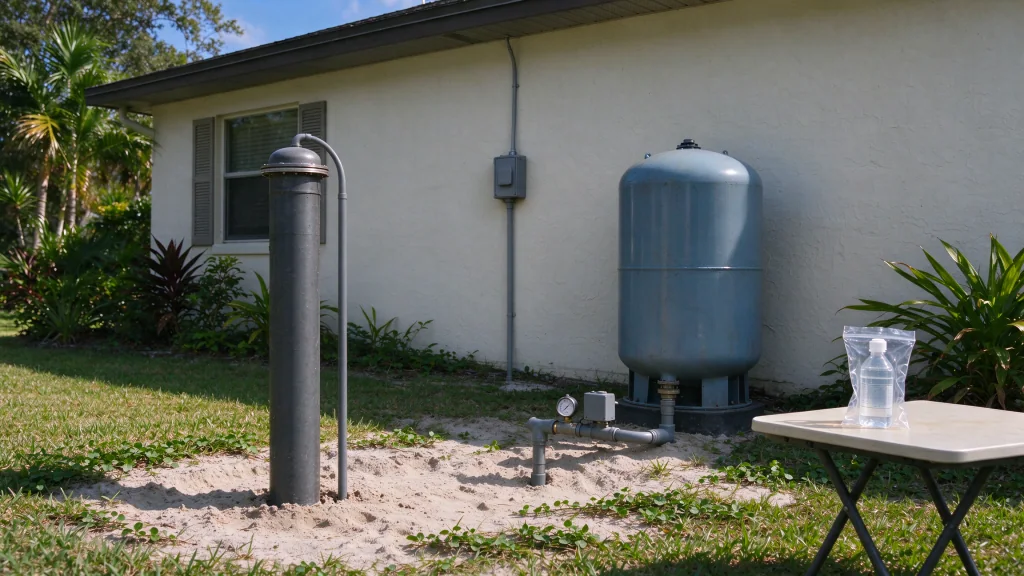
Start with electrical safety
Coastal Palm Bay Well Pump Repair offers well and pump service for private wells in Palm Bay and south Brevard, including the well system inspection that usually follows a flood. Before anything else, treat flooded well equipment as an electrical hazard. Pressure switches, control boxes, disconnects and wiring that sat in water can energize the ground or the water around them.
Do not touch or wade near submerged pump equipment, controls or wiring. Power to the well should be shut off at the breaker by a qualified person who can do so without standing in water. Do not restart the pump to test it, even after the water has gone down, until the equipment has been checked. Running a pump with wet controls or a flooded motor connection can damage the equipment and create a shock risk.
How can you tell whether floodwater reached the well?
If standing water covered the wellhead, assume it may have entered the well. Other signs include a missing, loose or cracked well cap, mud or debris around or on top of the casing, a wellhead in a low spot where water pooled, and water that turns cloudy, discolored or smells different after the storm.
A well whose casing ends below the surrounding flood level is more exposed than one with the casing well above grade and a sealed cap. DOH-Brevard final inspections check well height at final grade, one reason casing height matters. Even a well that was not visibly submerged can be affected if runoff ran across the wellhead or a cracked casing let shallow water in. Some contamination gives no visible sign at all, which is why testing matters more than appearance.
Do not drink the water until it has been disinfected and tested
The Florida Department of Health in Brevard County advises that after a private well is flooded, disinfection and testing may be needed once floodwaters recede. General public-health guidance from the CDC is the same in principle: do not use water from a flooded well for drinking, cooking, brushing teeth or making formula until the well has been disinfected and the water tested.
Clear water is not proof of safe water. Bacteria and nitrate are invisible and often tasteless, and a well can look and smell normal while carrying contamination from septic systems, livestock areas or fertilized ground that floodwater crossed. Use bottled water or another known-safe supply in the meantime.
Disinfection does not fix a damaged wellhead
Shock chlorination can reduce bacteria in a well and plumbing after a flood, but it only works for as long as nothing new gets in. If the cap is cracked, the casing is damaged, the sanitary seal has failed or the grout seal around the casing has washed out, contamination can return with the next heavy rain. Disinfecting a well that still has an open path from the surface treats the symptom, not the cause.
Disinfection also needs the floodwater gone and the well physically sound first. Chlorinating while the wellhead is still under water, or before debris has been cleared, wastes effort. And chlorination does not remove nitrate or chemical contamination, which is another reason testing follows disinfection rather than being skipped because the well was treated.
What to test for after a flood
Testing for total coliform bacteria and E. coli shows whether disease-causing organisms may be present, and a nitrate test shows whether fertilizer, septic or animal waste has reached the water. Samples go to a certified laboratory, which can explain how to collect the sample and when to take it after disinfection. Routine sampling of private wells is not mandated by the state, so the owner arranges it.
DOH-Brevard recommends annual coliform bacteria and nitrate testing for private wells, and lead testing every three years for most homeowners. A flood is a reason to test outside that schedule. If results come back positive after disinfection, the next step is finding how contamination is getting in, not repeating chlorination indefinitely. Our guide to water testing after pump repair covers sampling in more detail.
Checking the pump, controls and tank before restart
Once the area is dry and power is safely off, the equipment is checked before it is put back in service. The checks depend on what flooded.
- Pressure switch and control box: water and silt inside a switch or controller can corrode contacts and cause shorts; see well pump controls
- Surface jet pumps: a flooded motor may need drying, testing or replacement, covered under jet pump repair
- Submersible pumps: the motor is meant to be under water, but the wellhead wiring, splices and control box above ground are not; see submersible well pump repair
- Pressure tank: a tank that floated, tipped or sat in contaminated water may have a damaged base or fittings; see pressure tank replacement
- Wiring and breakers: if the pump trips the breaker on restart, stop and read our guide on a well pump tripping the breaker
Restarting the system
When the equipment has been cleared, the restart is gradual and observed. Floods often arrive with power outages, and the guide on a well pump after a power outage explains what normal restart behavior looks like. Expect possible air, cloudiness or sediment at first as the well and lines flush; if sand or grit continues, our guide to sand and sediment in well water explains what that can mean. A pump that runs again has not shown that the water is safe.
Repairing the wellhead, raising the casing or abandoning the well
If the inspection finds a damaged cap, the fix may be as simple as a new sanitary well cap. A cracked or corroded casing, a washed-out grout seal or a wellhead that sits too low for the site's flooding is a bigger job. Where the rules and the well's construction allow it, the casing may be extended so the top sits higher above grade. Work below ground on the casing or seal is licensed well repair performed by a Florida-licensed water well contractor, and where required to protect groundwater, prior permission is obtained first.
If the well is damaged beyond reasonable repair, or keeps testing positive because of its construction, the sensible path may be a new well through well drilling and sealing the old one through well abandonment, so the damaged bore does not remain a pathway into the aquifer. Where sediment or fouling from the flood has reduced yield, well rehabilitation may be worth assessing.
Utility notices do not describe your private well
After a storm, a water utility may issue a boil-water notice or lift one. Those notices concern the utility's distribution system. They say nothing about a private well, whose water comes from its own source. The reverse is also true: a lifted utility notice does not mean a flooded private well is safe. If a property has both utility water and a private irrigation well, each is treated separately.
Write down what happened
Note how high the water rose relative to the wellhead, how long it stood, what equipment was submerged and when power was shut off. Keep photographs, test results and repair records together. That history helps with insurance questions, later diagnosis and any future sale. To arrange an inspection after a flood, use the contact page and describe what was submerged.