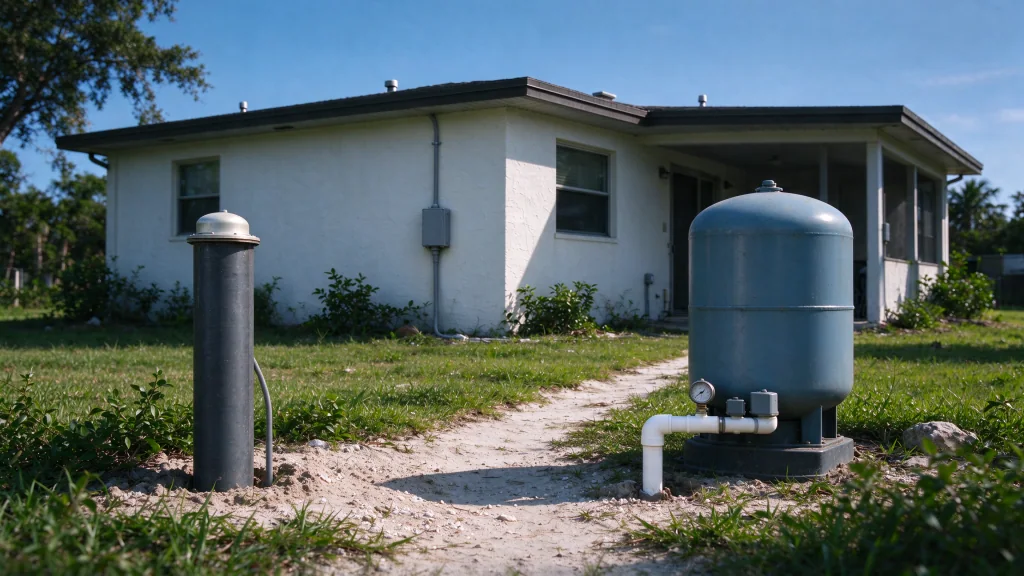
Start with what your well supplies
Coastal Palm Bay Well Pump Repair offers diagnosis and repair of existing residential well pump systems in Malabar. If you need well pump repair in Malabar, FL, the first thing we need to know is whether the well supplies your home, your irrigation system or both through separate equipment. A dry kitchen faucet calls for a different assessment than a sprinkler pump that will not start. That distinction also keeps a public-water interruption from being mistaken for a failed private well.
Malabar's rural residential character makes this an important question. The town's public facilities plan describes private potable wells alongside public utility service, with shallow groundwater playing a role in household supply. Your property's arrangement matters more than a general assumption about the town. We start with the equipment you actually have, where the water goes and when the problem began. If the house has stopped receiving water, our no-water diagnosis explains the checks that separate a power or control fault from a pump or source problem.
A falling water level can resemble a failing pump
A pump may sound normal while the water coming out of the well changes. Malabar's planning documents describe a surficial aquifer whose water level responds to rainfall. That does not tell us the depth or condition of your particular well. It does tell us why replacing a motor without looking at the supply can miss the cause of the complaint.
Tell us if the water weakens after a shower, returns after the system rests or changes during an extended dry spell. Those details help direct the assessment. Where needed, the diagnosis considers pumping water level, drawdown and recovery as well as the pump's electrical and pressure response. Our guide to pump trouble versus low well yield explains why a larger pump is not automatically the answer. Sometimes the equipment needs repair. Sometimes the available water or the way the system draws it needs further investigation.
Losing prime needs more than another restart
An aboveground jet pump depends on a sound suction arrangement. If it runs but fails to move water, loses prime overnight or sends bursts of air toward the house, we need to investigate why. A leak on the suction side can draw air without leaving the obvious puddle a homeowner expects. A valve that no longer holds can also let water drain back when the pump stops.
We assess the symptoms against the existing pump and piping before recommending parts. Jet pump repair covers that equipment; suction leak repair addresses the air-entry and drain-back side of the system. Do not keep allowing a pump to run without moving water while waiting for it to recover on its own. If you can safely use the normal disconnect from a dry location, switch it off and arrange an assessment. Leave covers, wiring and electrical tests to the contractor.
Quick pressure changes can point away from the motor
Watch what the pressure gauge does when someone opens a faucet. A rapid drop followed by repeated starts may indicate a pressure tank problem, although leaks and other faults can cause similar behavior. A pump that runs steadily but cannot reach its shutoff pressure presents a different set of questions. We use those patterns to decide what to test, rather than treating every weak shower as a worn-out pump.
A pressure tank replacement should match the system's required drawdown and control arrangement. Changing the tank's labeled size without checking its usable water storage may leave the pump starting too often. If the pressure is weak across the house, low well water pressure diagnosis also considers restrictions, leaks and demand. A clogged treatment component can reduce delivery even while the pump and tank are doing their jobs.
Useful well records can narrow the investigation
If you have the well completion report, an old equipment invoice or a readable pump label, keep it available. A completion report may establish construction details that cannot be confirmed by looking at the aboveground equipment. Brevard's health department explains how to locate well records through the district's permitting system and older county records. The completion report and the final site inspection are separate documents, so one does not necessarily substitute for the other.
For a house purchase, our well system inspection focuses on the existing equipment and observable operating condition, with further performance checks identified where appropriate. Discuss the inspection scope before relying on it for a closing. A brief run test cannot establish every seasonal supply condition, and a mechanical inspection does not replace laboratory water testing. The private-well homebuyer guide helps you organize the records and questions worth resolving before the deadline.
Plan the work around the whole property
On a property with a private well and septic system, access planning matters. Show us known underground service routes, the well location and any septic site plan you hold. Let us know about locked gates, close landscaping or an enclosure around the equipment. That information helps define how the work can proceed without assuming every yard offers the same access.
Pump work and structural well work also follow different rules. Florida's statutory definition of well construction excludes pump and pumping equipment installation, while its well-repair definition excludes portions above ground. That does not settle every municipal plumbing or electrical requirement. If an investigation points to casing work or another change to the well itself, the scope needs to be reviewed with the appropriate permitting authority. Our Florida well pump permit guide explains the distinction. On a rural Malabar lot, drilling a new well or abandoning an unused one is a separate permitted job with its own setback and records questions.
Decide what needs replacing after the fault is identified
We organize the proposed work around the diagnosed fault and the condition of the connected equipment. A failed control does not by itself justify replacing a working pump. Equally, replacing one inexpensive part makes little sense if a confirmed pump fault or damaged piping will leave the original problem unresolved. You should be able to understand the reason for the recommended scope before authorizing it.
For well pump replacement, the existing well and household demand guide the equipment selection. Horsepower alone does not describe the pressure and flow a pump can deliver at the required lift. A belowground installation can also involve retrieval, cable and drop-pipe condition, making submersible pump repair different from work on an accessible jet pump. We manage the agreed work with appropriately licensed and insured contractors, with the required trade responsibilities identified for the job.
Access changes what a diagnostic price covers. As a Florida budgeting example, pulling a pump for diagnosis without replacement has been advertised at $600 to $1,000. That is a regional example, not a verified Malabar rate, and it does not describe a simple aboveground switch repair. A replacement pump or damaged drop pipe would change the scope. The well pump cost guide separates diagnostic access from equipment replacement so the proposed total can be read alongside its inclusions.
Water returning to the faucet is only part of the answer
A clear stream at good pressure tells you the system is delivering water. It cannot establish that the water is safe to drink. That distinction is especially important after flooding or work that opens parts of a domestic well system. Brevard health guidance recommends annual coliform bacteria and nitrate testing for private wells. The testing needed after a particular incident depends on what happened and the public-health guidance for that situation.
If floodwater reached the well, explain that when requesting service rather than reporting only that the pump stopped. Disinfection and testing may be needed after floodwater recedes. Mechanical repair cannot resolve every contaminant, and appearance or odor cannot replace a laboratory result. Our water testing after pump repair guide separates equipment checks from sampling and the decisions that follow a test result.
Tell us what changed before the water stopped
You do not need to diagnose the equipment before contacting us. The most useful information is often simple: whether the house still has water, whether the pump can be heard, and whether the problem is constant or comes after sustained use. A photo taken safely from outside the equipment can help identify the arrangement. Include a pressure-gauge reading only if it is easily visible without touching covers or entering a wet electrical area.
Mention a recent outage, a new leak or earlier repair attempts. Do not repeatedly reset a tripping breaker or bypass a switch to get the motor running. We use your description to plan the assessment, explain the proposed scope and identify any further investigation. For nearby properties, compare our Grant-Valkaria coverage or return to the service areas overview. You can request service with the details you already know.